

My Neighbors Are Driving Me Crazy: Why Every Sound Feels Unbearable—and What Can Help
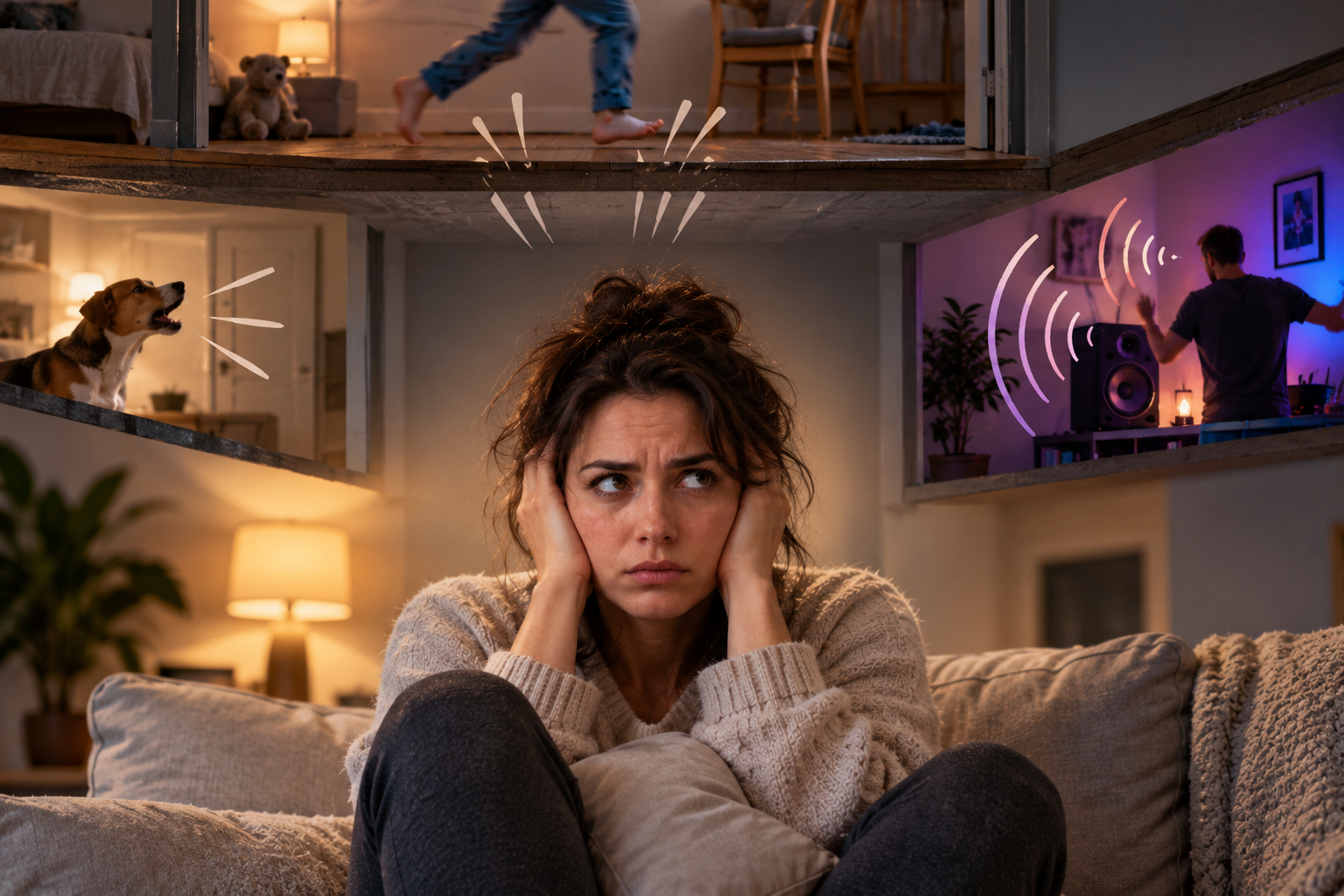
Upstairs footsteps, slamming doors, barking dogs, and bass through the walls. Why neighbor noise can take over your life, and how to begin getting some peace back.
By Dr. Ezra Cowan, Clinical Psychologist | Center for OCD and Misophonia
You finally get home after a long day. You sit down on the couch, hoping to relax.
And then you hear it.
Thump. Thump. Thump.
Your upstairs neighbor is walking around again.
A few minutes later, there's the familiar scraping sound of furniture being dragged across the floor. Then a door slams. Maybe their child starts running back and forth.
Or perhaps it's the neighbor next door. You hear the muffled sound of their television, the rhythmic bass of their music, or their dog barking through the wall.
You feel your body tense.
Seriously? Again?
You wonder how someone could possibly make so much noise. You try turning on the television, putting in headphones, or distracting yourself with something else.
But you keep listening.
And perhaps the most frustrating part is that even when the noise finally stops, you can't fully relax.
Because you know it's going to start again.
For some people, this experience becomes much more than an annoyance. It can begin to dominate their lives, interfere with sleep, create resentment toward their neighbors, and make their own home feel like a place they cannot escape.
In my clinical work with individuals struggling with misophonia and sound sensitivity, one of the most important things I explore is how the experience of unwanted sound can develop into an ongoing struggle with something we feel powerless to change.
What Neighbor Sounds Drive People Crazy?
When people think of noise problems with neighbors, they often imagine loud parties or blasting music.
But for many people, the most distressing sounds are ordinary, repetitive noises that others might barely notice.
Some common examples include:
Upstairs neighbors:
Heavy footsteps, stomping, or pacing across the floor
Children running, jumping, or dropping toys
Chairs scraping and furniture being dragged
Objects repeatedly dropping onto the floor
Shoes or high heels clicking against hardwood floors
Vacuum cleaners and washing machines
Beds creaking or rhythmic banging against the floor
Next-door neighbors:
Doors and kitchen cabinets repeatedly slamming
Television voices or music heard through a shared wall
Deep bass that seems to vibrate through the apartment
Loud conversations, laughter, or phone calls
Dogs barking, whining, or scratching
Coughing, throat clearing, or other repetitive human sounds
Alarm clocks, electronic beeping, or constant buzzing
Other people become particularly bothered by plumbing sounds, footsteps in shared hallways, garage doors opening and closing, or the low humming of building equipment.
Interestingly, the most distressing sound is not always the loudest.
Someone may tolerate considerable traffic noise outside their window but become intensely agitated by the relatively faint sound of their neighbor's television.
And this raises an important question.
Why does a sound that might seem relatively minor become so difficult to tolerate?
Is This Misophonia, or Am I Just Annoyed by My Neighbors?
It is important to distinguish between ordinary frustration with noise and a condition such as misophonia.
Sometimes the problem really is that the neighbors are excessively loud. Being repeatedly awakened by heavy banging, music, or other disturbances would understandably frustrate almost anyone.
Not every intense reaction to neighbor noise is misophonia.
Misophonia involves a decreased tolerance for particular sounds or patterns of sounds that produce unusually strong emotional and physiological responses.
A person may experience intense anger, anxiety, disgust, or a powerful urge to escape or make the sound stop.
Importantly, the reaction is not necessarily determined by how loud the sound is.
For example, someone might become intensely distressed by the repetitive sound of footsteps overhead, even though the same person can tolerate much louder sounds in other settings.
The particular pattern of the sound, the context, and what it has come to represent may all influence the reaction.
Other factors, including poor sleep, anxiety, hearing-related sensitivities, or chronic stress, can also contribute.
What matters clinically is understanding the nature of the response rather than automatically assuming that every person distressed by neighbor noise has misophonia.
Why You Start Listening for Your Neighbors Even When They're Quiet
One of the most interesting things about severe sound sensitivity is how the experience can extend far beyond the sound itself.
Imagine that your upstairs neighbors come home every evening at approximately six o'clock.
You know that shortly afterward, you'll begin hearing footsteps and furniture moving.
By five thirty, you might already find yourself feeling tense.
You begin wondering whether they're home.
You listen for the door.
Perhaps you even notice yourself becoming irritated as soon as you hear their keys turning in the lock.
The footsteps haven't started yet.
But you're already experiencing distress.
This is what we mean by anticipatory anxiety.
Over time, the mind can become increasingly vigilant for the next unwanted sound. You might find yourself monitoring the ceiling, listening through the walls, or attempting to predict when the disturbance will begin.
And the more you monitor, the more prominent the sounds may become in your awareness.
Eventually, your attention may become so focused on your neighbor that it's difficult to fully engage in anything else.
You might be watching a movie, spending time with your family, or reading a book, but part of your attention remains directed toward the apartment above you.
Are they walking around? Was that a chair? Are they about to start again?
The problem has expanded from an unpleasant sound into an ongoing state of anticipation.
The Feeling of Being Trapped in Your Own Home
In my clinical experience, one of the most difficult aspects of neighbor-related sound distress is the feeling of helplessness.
Your home is supposed to be the place where you can relax.
You want to come home, shut the door, and have some peace.
But now someone else's behavior seems to determine whether you can feel comfortable.
And unlike a situation at work or a restaurant, you cannot simply leave your home every time a triggering sound occurs.
This can create an especially painful emotional experience.
I can't even relax in my own apartment.
Why should I have to live like this?
They shouldn't be allowed to make this much noise.
I need this to stop.
These thoughts are often completely understandable.
But they also reveal something important.
There may be two layers to the suffering.
The first is the immediate discomfort or emotional reaction caused by the sound.
The second is the struggle with the fact that the sound is happening at all.
The person feels that their ability to relax, feel safe, or enjoy their home depends on the noise stopping.
And when the noise continues, they may feel increasingly angry, powerless, and desperate.
Sometimes the struggle to make the sound stop becomes almost as consuming as the sound itself.
Why Trying Harder to Control the Noise Can Make You Feel Worse
When noise is distressing, the natural response is to try to eliminate it.
You might speak to your neighbor, contact building management, buy noise-canceling headphones, use a white-noise machine, or consider moving.
Some of these steps are entirely appropriate. Excessive noise, particularly at night, may require practical intervention.
But sometimes a person begins organizing more and more of their life around controlling the sounds.
They repeatedly check whether their neighbors are home.
They listen closely to figure out exactly where a noise is coming from.
They spend hours researching soundproofing solutions.
They rehearse confrontations or mentally replay everything their neighbors have done.
And when one noise finally disappears, they begin noticing another.
The challenge is that no apartment, even a relatively quiet one, can guarantee the complete absence of unwanted sound.
When someone begins to believe that they cannot be okay unless their environment is quiet, they can become increasingly dependent on something they cannot fully control.
This is often an important part of the work I do with individuals struggling with severe sound sensitivity.
How to Cope When Your Neighbors' Sounds Are Driving You Crazy
The goal is not simply to convince yourself that the sounds aren't bothersome.
Nor is it to force yourself to tolerate unreasonable noise.
Instead, it can help to work on two things simultaneously: addressing the environment where appropriate and changing your relationship with the distressing experience.
1. Address Reasonable Noise Problems
There is nothing wrong with respectfully asking neighbors to reduce excessive noise, particularly during sleeping hours.
Depending on the situation, practical steps may include communicating with building management, using rugs or furniture pads, identifying building-related sound transmission problems, or making reasonable adjustments to your environment.
These steps can meaningfully improve quality of life.
The important distinction is between taking reasonable action and becoming caught in an endless effort to guarantee that you will never hear another unwanted sound.
2. Start Noticing What You Feel, Not Just What You Hear
When you hear the familiar footsteps upstairs, your attention probably goes immediately to the noise.
But consider turning some of that attention toward what is happening inside you.
Are you angry?
Do you feel helpless?
Do you feel trapped?
Are you anxious about how long the noise will continue?
Is there a sense of unfairness or disappointment that you cannot have the quiet you want?
You don't necessarily have to do anything with these feelings.
The initial task is simply to recognize them.
Many people become so focused on stopping the noise that they rarely pay attention to the emotional experience underneath their reaction.
Learning to recognize those emotions can create an opportunity to respond differently.
3. Recognize the Reality You're Struggling With
Imagine hearing your neighbor walking upstairs.
You might notice yourself thinking:
They need to stop.
This shouldn't be happening.
I can't live like this.
Rather than debating whether these thoughts are reasonable, consider acknowledging the difficult reality you're encountering.
My neighbor is walking around upstairs.
I really don't want to hear it.
I feel angry and helpless.
And right now, I cannot make the sound disappear.
Notice that this isn't about telling yourself that the sound is okay.
It isn't about agreeing that your neighbor should be making noise.
It's about acknowledging what is happening, including your very understandable wish that things were different.
There is often real sadness, frustration, or helplessness associated with recognizing that we cannot always change our circumstances.
And sometimes our efforts to avoid those feelings become part of what keeps us struggling.
4. Practice Moving Forward Without Waiting for Perfect Quiet
Suppose you're reading a book and hear your neighbor dragging a chair across the floor.
Your instinct may be to stop reading and focus on the sound.
You might begin wondering whether they'll do it again.
Perhaps you wait a few minutes to make sure the apartment is quiet before returning to your book.
What if, instead, you practiced a different response?
You acknowledge the sound and the distress it brings up.
You allow yourself to feel upset without requiring the feeling to disappear.
And then you gently return to your book.
You aren't pretending that the noise doesn't bother you.
You're practicing the ability to continue living your life even while an unwanted experience is present.
This may feel quite difficult initially.
But developing greater flexibility around distressing experiences can be an important treatment goal.
For someone with significant misophonia, this is best developed gradually and collaboratively rather than through overwhelming or forced exposure.
What if My Neighbors Really Are Inconsiderate?
Sometimes they are.
Not every conflict needs to be explained psychologically, and people should not be expected to tolerate genuinely unreasonable behavior.
But here is a distinction I find particularly valuable.
You can recognize that your neighbor is behaving inconsiderately without making your emotional well-being entirely dependent on getting that person to behave differently.
You can take practical action while also working on your capacity to manage the frustration, disappointment, and helplessness that arise when the situation doesn't immediately change.
These two approaches are not contradictory.
You don't have to choose between advocating for yourself and learning to respond differently to difficult emotions.
Both can be important.
Can Therapy Help With Misophonia Caused by Neighbor Noise?
For some individuals, neighbor-related noise distress is part of a broader pattern of misophonia. Others may primarily be struggling with anxiety, hypervigilance, sleep disruption, or the effects of living in an excessively noisy environment.
A careful assessment can help clarify what is contributing to the difficulty.
For people with misophonia, research on cognitive behavioral therapy has shown promising results, although treatment remains an evolving area of study.
In my clinical work, I place particular emphasis on helping individuals recognize their emotional responses, understand the struggle with unwanted experiences, and develop greater flexibility when circumstances are not as they wish them to be.
This doesn't mean that the sounds must become pleasant or that the person should stop advocating for reasonable accommodations.
The goal is something more meaningful.
It is to help people regain the ability to live their lives without every moment being organized around anticipating, preventing, or escaping the next sound.
Getting Your Home Back
If you've been struggling with noise from your neighbors, you may have reached a point where you feel that the only way to be happy again is for the noise to stop.
Perhaps you've even begun thinking that you'll never be comfortable until you move.
Sometimes changing your living situation really is the appropriate choice.
But it's also worth considering whether the ongoing struggle with the sounds has begun taking up more of your life than you want it to.
Can you allow yourself to feel frustrated without spending the next hour thinking about your neighbors?
Can you hear an unwanted sound without immediately abandoning what you're doing?
Can you feel helpless about something you cannot control and still find a way to engage with the things that matter to you?
These are not easy questions.
But they point toward an important possibility: Even when we cannot fully control our environment, we can develop a greater capacity to live with the difficult emotions that arise in response to it.
And sometimes, that is what allows home to begin feeling like home again.
About the Author
Dr. Ezra Cowan is a clinical psychologist and founder of the Center for OCD and Misophonia, a specialized practice treating misophonia, OCD, anxiety, and related conditions. His clinical work emphasizes understanding the emotional processes underlying distress and helping individuals develop greater flexibility in responding to unwanted experiences.
If sensitivity to neighbor sounds, anticipatory anxiety, or misophonia is interfering with your daily life, specialized psychological treatment may help.